
CMOS Cameras
CMOS (Complementary Metal-Oxide-Semiconductor) cameras are a type of digital camera used in many fields, such as photography, surveillance, medicine and industry.
Discover the world of CMOS cameras! These innovative cameras use a CMOS sensor that converts light into digital signals to produce high-quality images and videos. Compared to conventional CCD (Charge-Coupled Device) cameras, CMOS cameras offer higher sensitivity, better image quality and lower power consumption. Our range of CMOS cameras is ideal for applications such as photography, surveillance, medicine and industry. With their high resolution, wide dynamic range and ability to operate in various lighting conditions, they are the perfect choice for anyone requiring high-quality images and videos.
An important consideration when selecting a CMOS camera is the choice between colour and monochrome sensors. Colour sensors are ideal for applications where colour information is important, such as in photography or surveillance. They offer high colour fidelity and good image quality, but may struggle in low-light conditions.
Monochrome sensors, on the other hand, are ideal for applications where the highest possible sensitivity and resolution are required, such as in medicine or industry. They offer higher sensitivity and better image quality in low-light conditions, but only produce black-and-white images. Monochrome sensors are often more expensive than colour sensors and offer higher frame rates.
Advantages of colour sensors
- High colour fidelity
- Good image quality
- Ideal for applications where colour information is important
- Potential time savings
Disadvantages of colour sensors
- Difficulties in low-light conditions
- Higher cost compared to monochrome sensors
Advantages of monochrome sensors
- Higher sensitivity
- Better image quality in low light conditions
- Faster image capture
Disadvantages of monochrome sensors
- Only produce black-and-white images
- Not ideal for applications where colour information is important
- Time-consuming if a colour image is to be created
From black and white to colour
In astrophotography, however, it is possible to create a colour image from a black-and-white image by using different filters. This process is known as ‘colour synthesis’. It involves taking several exposures with different filters to capture the various colour channels.
The most common filters used in astrophotography are
- Luminance filter (L): Captures the overall brightness of the image
- Red filter (R): Captures the red colour channels
- Green filter (G): Captures the green colour channels
- Blue filter (B): Captures the blue colour channels
- H-alpha filter: Captures the specific wavelength of 656.3 nm emitted by ionised hydrogen atoms
- O-III filter: Captures the specific wavelength of 500.7 nm emitted by ionised oxygen atoms
By using these filters, one can capture the different colour channels and later combine them into a colour image. However, this process requires careful planning and execution to ensure that the different colour channels are combined correctly (image processing to follow).
A popular method for combining colours in astrophotography is the so-called ‘Hubble palette’. This palette was developed by NASA astronomers and uses a specific combination of colours to represent the different wavelengths of light.
The Hubble palette uses the following colours
- Red: H-alpha filter (656.3 nm)
- Green: OIII filter (500.7 nm)
- Blue: SII filter (672.4 nm)
By combining these colours, one can create a colour image that represents the different wavelengths of light in astrophotography. The Hubble palette is a popular choice amongst astrophotographers as it offers a realistic and aesthetically pleasing representation of colours in space.
We hope this information helps you to quickly understand the advantages and disadvantages of colour and monochrome sensors, and how to create a colour image from a black-and-white image in astrophotography.
Conclusion
So, if you’re short on time, go for a colour camera; everyone else who wants to get the most out of it should opt for a monochrome camera plus filters. The subsequent image processing can take several hours in both cases.
We do not offer every camera here, but only those from manufacturers we have been working with since the very beginning (e.g. ALccd (QHY)), as their support and camera performance are simply the right fit for professional applications.
Furthermore, we do not brand ToupTek cameras with our own label; it would only make them unnecessarily more expensive (incidentally, ToupTek and QHY do not work together, as a ‘fellow retailer’ claims, simply to maximise his profits!).
Incidentally, the differences between the individual manufacturers lie in the details:
The sensor is the same (e.g. Sony IMX…), but the memory size and storage speed(!), etc., differ in some cases significantly, and those who buy cheaply here usually end up buying twice.
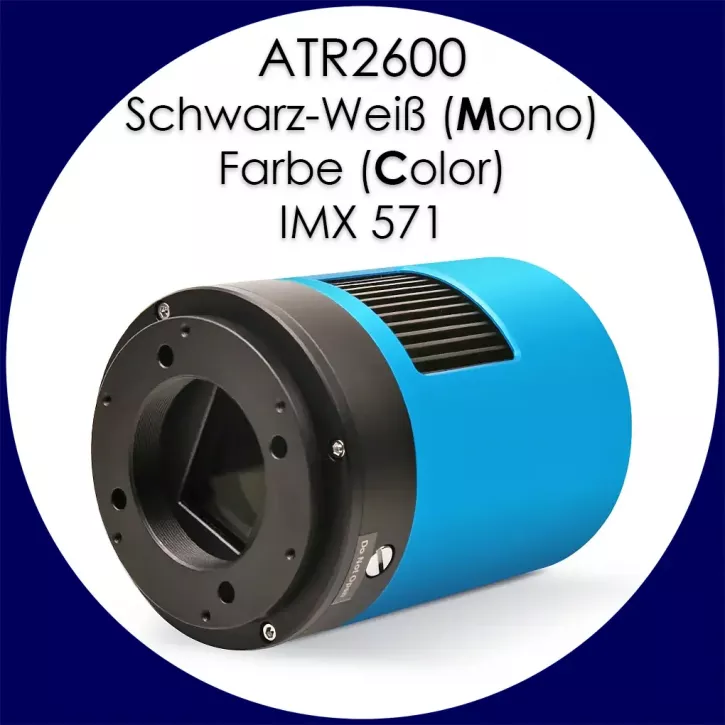
- 26 MP
- Mono & Color
- IMX 571
- 3,76µm²
- APS-C
1.450,00 EUR - 1.850,00 EUR
incl. 19 % VAT excl. shipping costs
 Gewöhnlich versandfertig in 24 Stunden
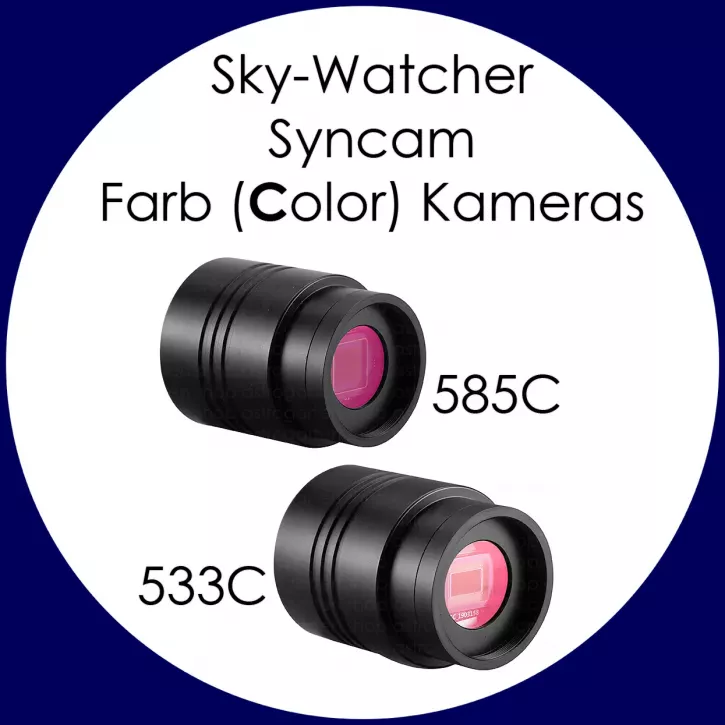
Sky-Watcher Syncam Color Cameras
- 585C
- 533C
- Passive Cooling
365,00 EUR - 599,00 EUR
incl. 19 % VAT excl. shipping costs
Gewöhnlich versandfertig in 24 Stunden
