
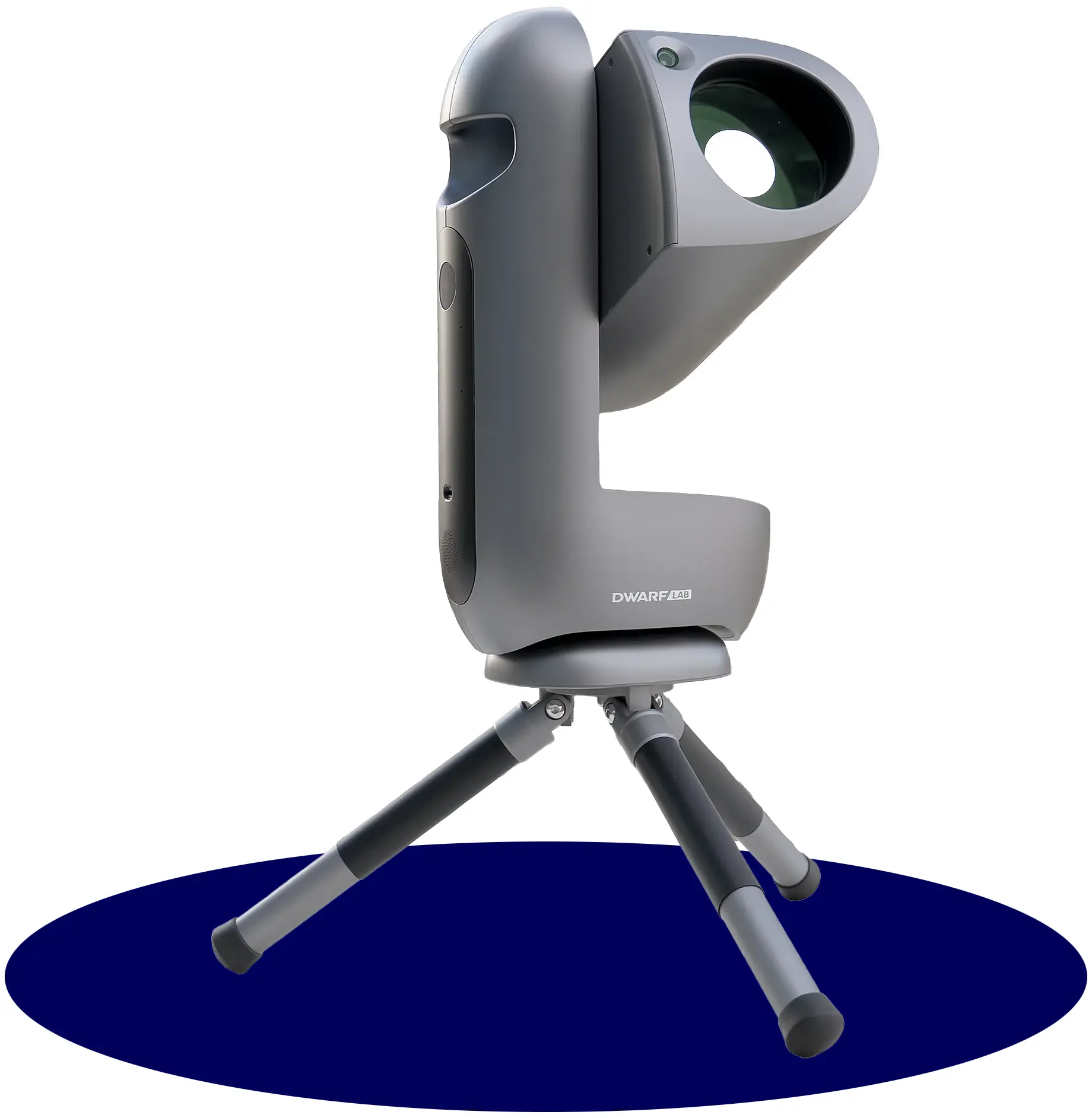
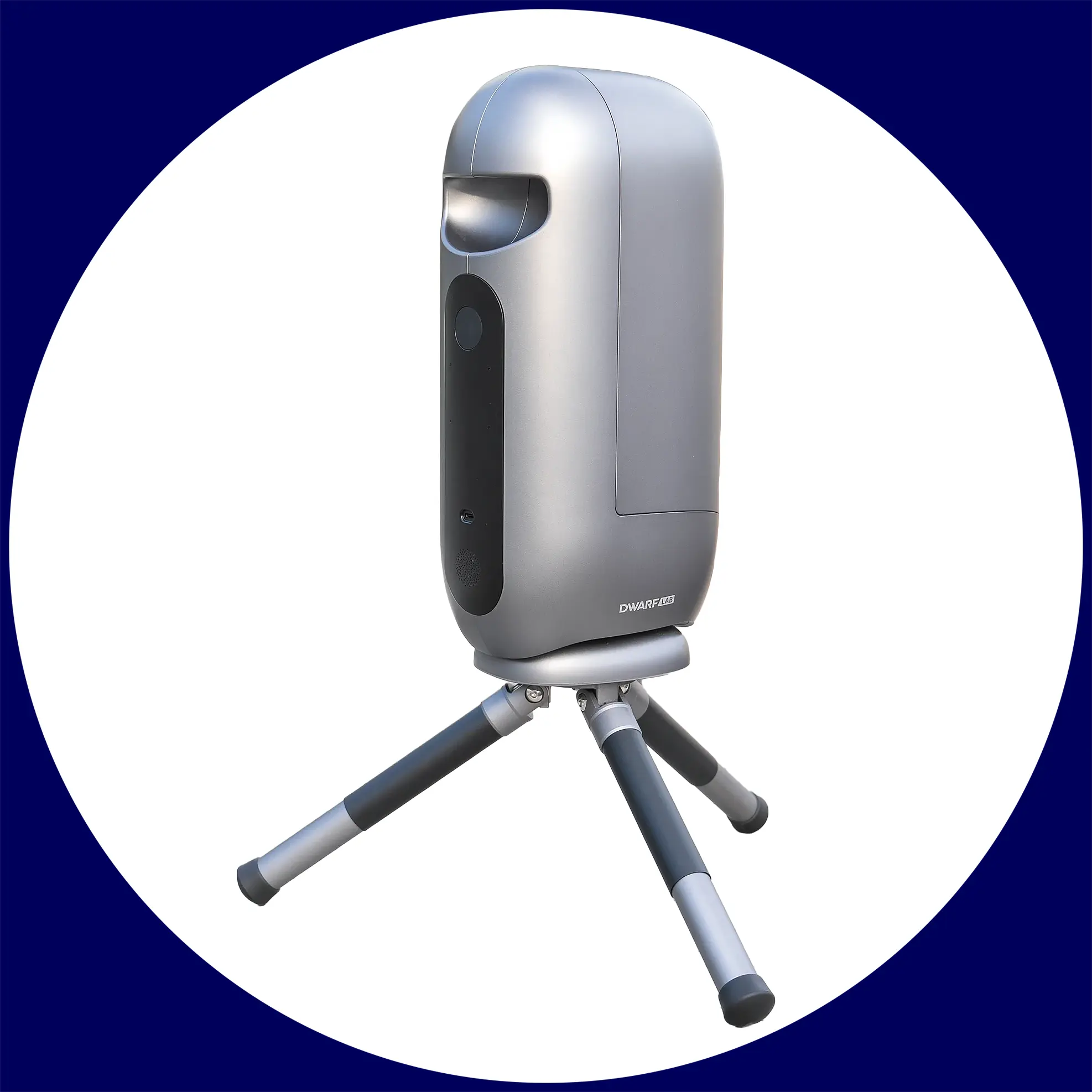
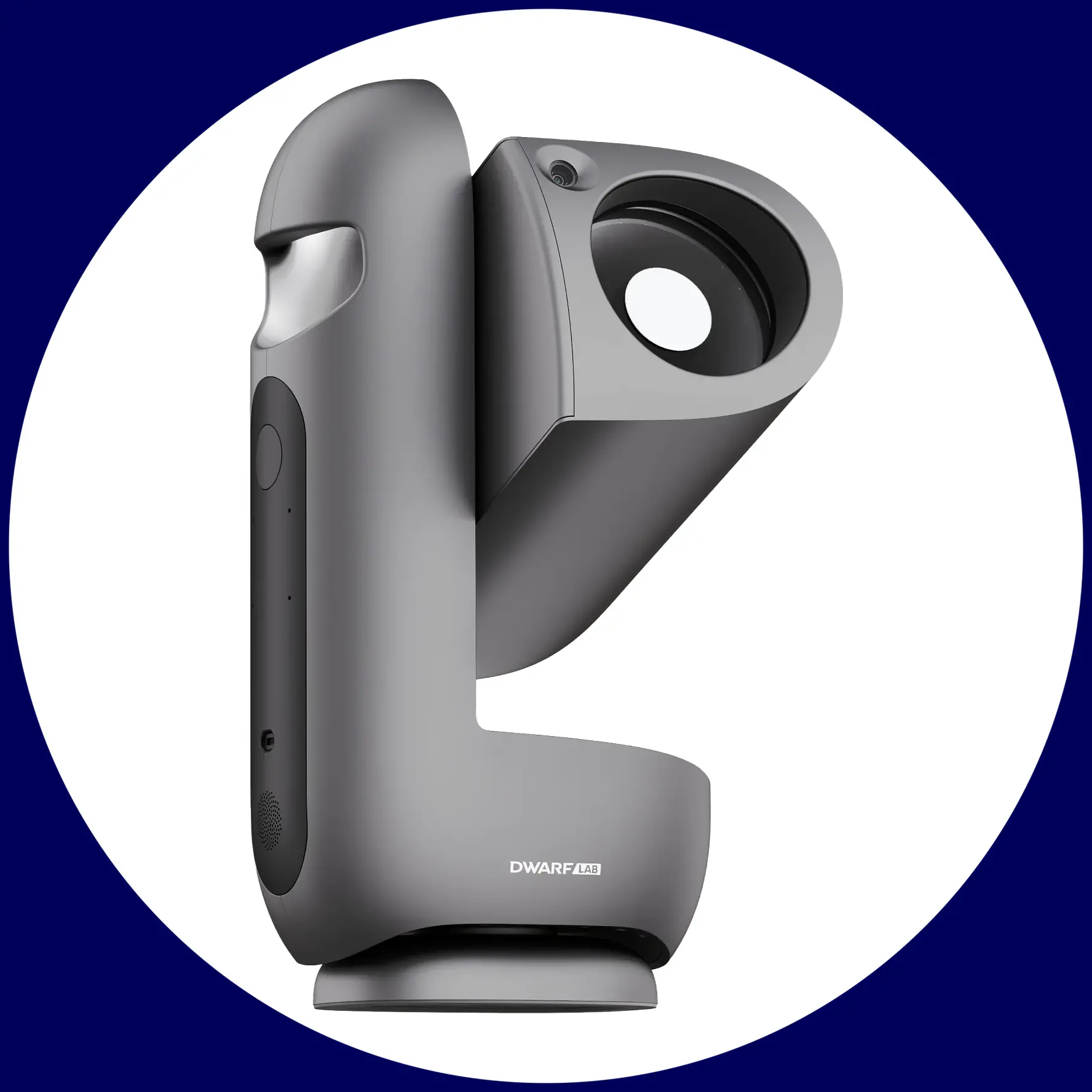
DWARFLAB Dwarf Draco Smart-Telescope 90 mm – Standard Edition

Product.Nr.:
DL#10092
EAN: 6977252010092
products condition: new
Manufacturer: DWARFLAB
1.499,00 EUR
incl. 19 % VAT
-
 Nicht auf Lager
- delivery time : bitte erfragen
- Delivery time currently unknown, unfortunately.
- Fully automatic smart telescope with 90 mm aperture – around 3 times more light than 50 mm smart telescopes
- Fast folded optics 90/340 mm (f/3.8) – colour-corrected, sharp stars right to the edge
- Two cameras at once: telephoto (1/1.3" 50 MP sensor, 12 MP output) and ultra-wide-angle (85.7° field of view)
- Single exposures of up to 300 seconds thanks to an integrated guide camera and rotating sensor – no polar alignment
- TEC sensor cooling (approx. 5 °C below ambient) and automatic dew prevention using waste heat
- IP55 rating – protected against dust and water jets
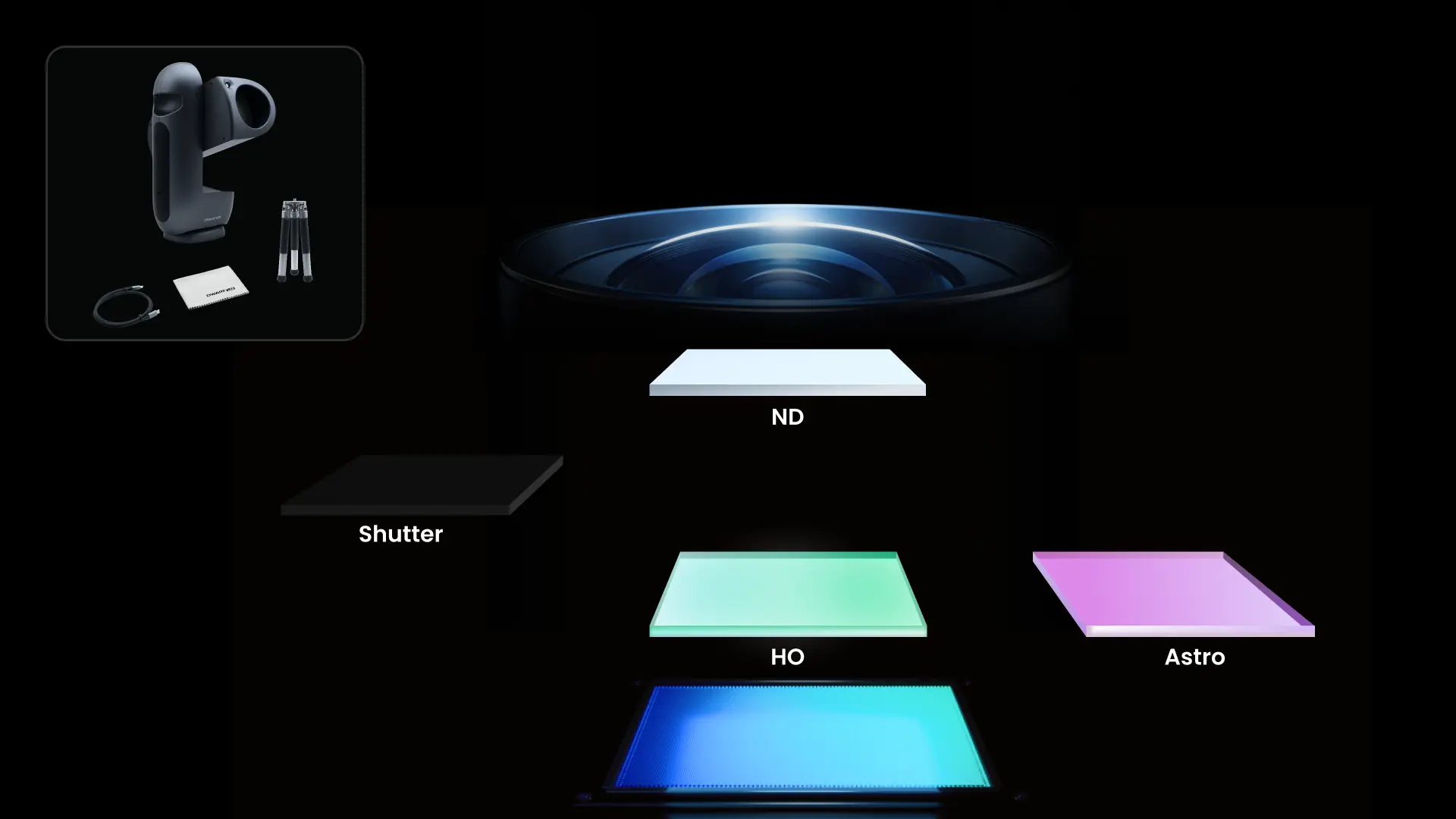
- Built-in filters: astro, dark, Hα + O III dual narrowband (13 nm) and ND solar filter that swings in automatically
- Remote control via app, scheduled imaging, mosaics and stacking across several nights
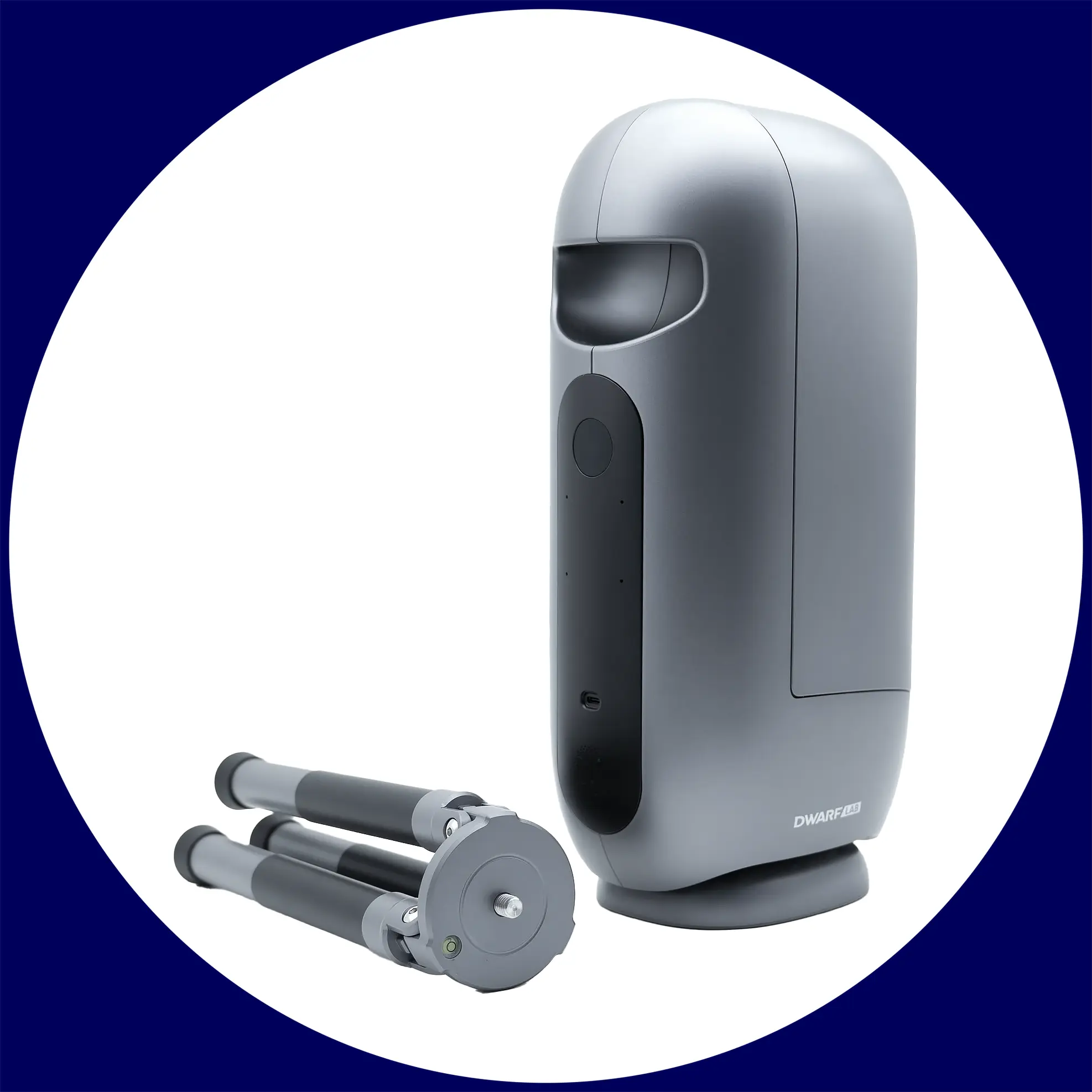
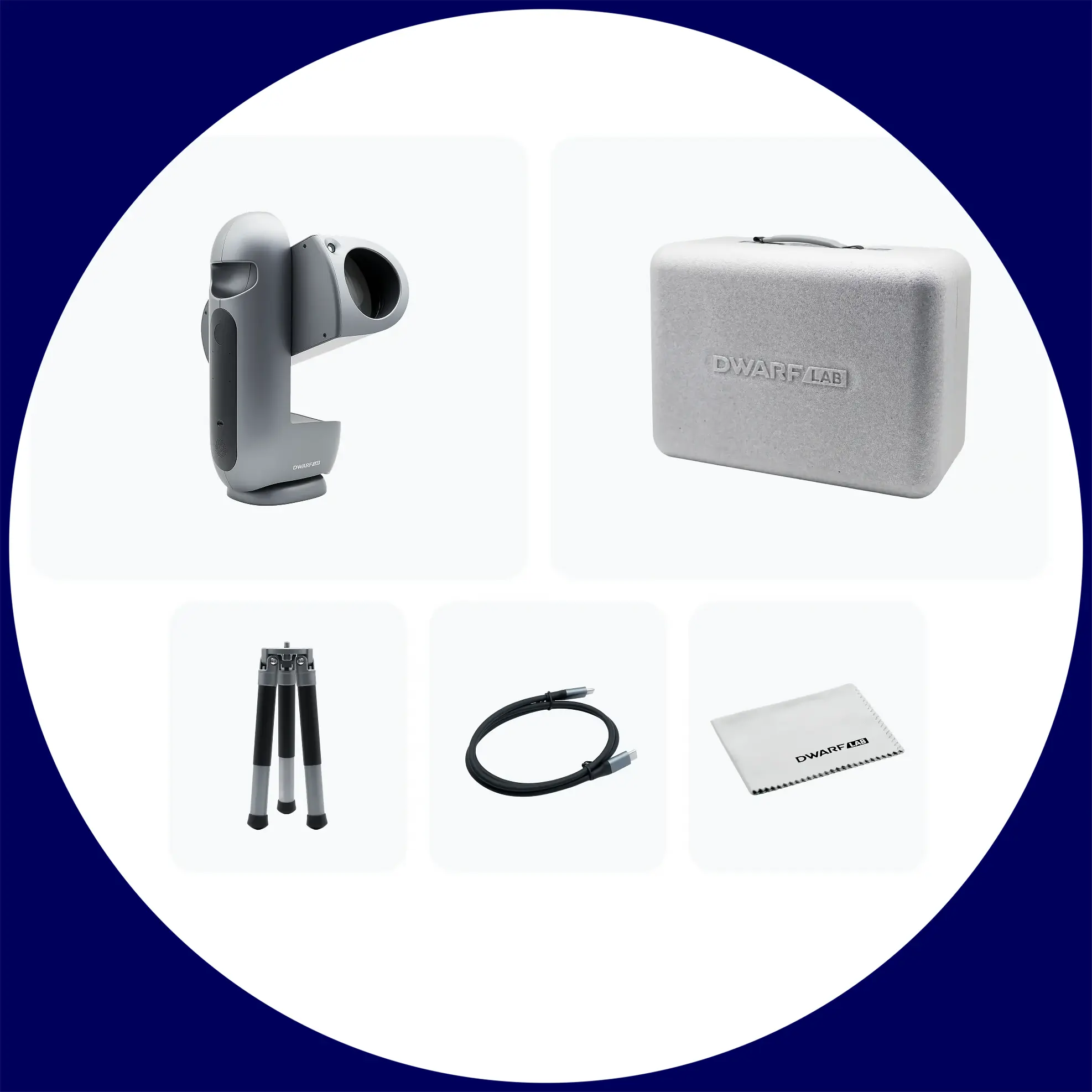
- 5.5 kg, battery for approx. 5 hours, aluminium table tripod and protective case included
DWARFLAB Draco – a portable observatory
With the Draco, DWARFLAB introduces the next class of smart telescope: 90 mm aperture, a fast focal ratio of f/3.8 and single exposures of up to 300 seconds – figures previously reserved for a traditional astrophotography setup with mount, camera and laptop. The Draco packs all of this into one compact housing, controlled from your smartphone or tablet.
Set it up and tap a target in the app – the Draco handles focusing, alignment, tracking, calibration and stacking of the individual frames on its own. You watch on the screen as your nebula or galaxy gains detail frame by frame.
For more information, sample images and a comparison of the two editions, see our Draco info page.
90 mm aperture – more light, more detail
Aperture determines how much light a telescope collects and how finely it resolves. At 90 mm, the Draco gathers around 165 times more light than the dark-adapted eye and over 3 times as much as a smart telescope with a 50 mm aperture. Faint structures in nebulae and galaxies therefore show up faster and with less noise.
Just as important is resolving power: the larger the aperture, the finer the detail a telescope can separate. At 90 mm, the Draco resolves almost twice as finely as a 50 mm smart telescope and three times as finely as a 30 mm one. Extended objects such as the Moon, the Sun, galaxies, nebulae and star clusters therefore show considerably finer detail, such as lunar craters or dust lanes in galaxies. Close double stars are split more cleanly.
The folded optics fit a 340 mm focal length into a housing just 386 mm tall. At f/3.8 they are very fast: a faint nebula needs considerably less total exposure time than with a typical f/5.6 system.
Two cameras, one sky
The telephoto camera with its 1/1.3" sensor (50 MP) delivers the detailed images. For deep-sky objects it combines every 4 pixels into one (2×2 binning, 2.4 µm, 12 MP), which noticeably improves the signal-to-noise ratio. For the Sun, Moon and planets it uses the full resolution of the 1.2 µm pixels.
At the same time, the wide-angle camera with an 85.7° field of view captures the surroundings – ideal for the Milky Way, star trails and landscapes. In one night you get both a detailed and a wide view of the same sky.
300-second exposures – without polar alignment
Smart telescopes normally operate in alt-azimuth mode (level), which causes field rotation: the longer the exposure, the more the stars rotate around the centre of the image. The Draco tackles this in three ways:
- Integrated guide camera: monitors the stars and corrects tracking errors in real time
- Rotating sensor: the camera sensor physically rotates with the sky and compensates for field rotation
- Precision drive with ultra-fine step control for smooth, low-backlash movement
For objects very close to the zenith, where field rotation is particularly fast, the Draco can also be operated in equatorial mode – the app guides you through the setup step by step.
Well-thought-out technology
- TEC sensor cooling: equipped with a TEC thermoelectric cooler and fan, the system features automatic TEC thermal control. It lowers the sensor temperature by approx. 5 °C below ambient, fundamentally reducing thermal noise in long exposures and delivering clean imaging data.
- Dew prevention using waste heat: heat from the electronics keeps the lens free of dew – all night long
- Operating range from -20 °C to +45 °C, housing rated IP55 against dust and water jets
- Freely rotatable framing: portrait, landscape or any angle you like – the sensor rotates accordingly
- Automatic calibration: flats and bias frames are stored, dark frames are taken and applied automatically during the session
A filter for every target
The Standard Edition has the following built-in filters, switched automatically via the app:
- Astro filter (430–690 nm) for galaxies, star clusters and broadband objects
- Hα + O III dual narrowband filter with 13 nm bandwidth each – for emission nebulae, even under light-polluted urban skies
- Dark shutter for automatic noise correction
- ND solar filter (OD 5) that swings in automatically for solar imaging – even remotely, with no need to fit a filter by hand
Tip: if you would like to capture nebulae in the famous "Hubble palette" (sulphur, hydrogen, oxygen), the Draco SHO Edition is the right choice.
App, remote control & automation
The Draco is controlled with the free DWARFLAB app (iOS & Android) via Wi-Fi, Bluetooth or NFC. The app shows in real time which objects are well placed, helps you find your way with an AR sky finder and selects all settings automatically in Auto mode. In Pro mode you have full control over exposure (1/10,000 s to 300 s), gain and filters.
- Remote control (PhotonLink): operate the Draco from anywhere, e.g. when set up at a dark site
- Wired network: via USB Ethernet for permanent installations
- Schedule: set the target, time and settings – the Draco starts on its own
- Mosaic: up to approx. 3 times larger field of view by automatic stitching
- Stacking across several nights and discarding poor frames afterwards
- In-app editing: reduce or remove stars, noise reduction, Hubble palette and much more
- Export as JPG, PNG, TIFF and FITS – for further processing in your usual software
Sun and Moon
In Solar System mode, the Draco centres, focuses and tracks the Sun and Moon at the touch of a button. On the Standard Edition the ND solar filter swings in automatically – handy for sunspots or a solar eclipse, for example.
!!! SAFETY WARNING: The built-in solar filter is intended exclusively for photographic imaging with the Draco. Never look at the Sun without a tested solar filter – neither with the naked eye nor through any optical instrument. For your own observing, please use certified eclipse glasses or Baader AstroSolar solar filter film. The manufacturer also recommends avoiding solar imaging around midday in high summer; morning or late afternoon is better.
Good to know
- The Draco is a purely photographic telescope – you view the image on a smartphone, tablet or TV; there is no eyepiece to look through.
- The telephoto field of view is approx. 1.65° × 1.24° (about 3 full Moon diameters). Very large objects such as the Andromeda Galaxy can be captured using the mosaic function.
- The Draco is only of limited use for planets: at 340 mm focal length, Jupiter and Saturn appear small. For planetary detail, a traditional telescope with a long focal length is the better choice.
- The Draco largely handles image processing itself. This is convenient, but you cannot follow every step in detail. If you want to know exactly what happens to your image, save the raw data (FITS/TIFF) as well and process it yourself.
- At 5.5 kg the Draco is easy to carry, but noticeably heavier than the small 50 mm smart telescopes.
- The battery lasts approx. 5 hours. For whole nights we recommend a power bank or mains adapter via USB-C.
- Galaxies and broadband objects benefit greatly from a dark site; for emission nebulae under urban skies the Hα + O III filter helps.
Technical data
| Model | DWARFLAB Draco smart telescope – Standard Edition |
| Type | Fully automatic smart telescope (photographic), usable in alt-azimuth and equatorial mode |
| Telephoto optics | Folded, aberration-corrected optics, aperture 90 mm, focal length 340 mm |
| Focal ratio | f/3.8 |
| Wide-angle optics | Aperture 2.96 mm, focal length 5.56 mm |
| 35 mm equivalent focal length | Telephoto: 1200 mm (astro mode), 1280 mm (other modes) Wide-angle: 23.3 mm |
| Field of view, telephoto | Astro mode: 1.649° × 1.238° (diagonal 2.059°) Other modes: 1.549° × 1.162° (diagonal 1.936°) |
| Field of view, wide-angle | 73.20° × 58.23° (diagonal 85.74°) |
| Field of view, guide camera | 0.905° × 0.512° (diagonal 1.040°) |
| Focus range, telephoto | 25 m to infinity |
| Telephoto sensor | OmniVision OV50Q40, 1/1.3", 50.33 MP, pixel size 1.197 µm |
| Wide-angle sensor | OmniVision OV50E40, 50.33 MP |
| Guide camera sensor | OmniVision OS04C1B, monochrome, 4.09 MP |
| Binning / output resolution | 2×2 (2.394 µm) / 12 MP (telephoto and wide-angle), aspect ratio 4:3 |
| Image scale, telephoto | approx. 1.45″/pixel (2×2 binning), approx. 0.73″/pixel (native) |
| Exposure time | 1/10,000 s to 300 s |
| Sensor cooling | TEC (thermoelectric) with fan, automatic thermal control, approx. 5 °C below ambient |
| Telephoto filters (built-in) | Astro: 430–690 nm Dark: fully light-tight Dual narrowband: O III 500.7 nm + Hα 656.3 nm, 13 nm FWHM each ND: OD 5 (400–1000 nm) |
| Wide-angle filters (built-in) | VIS: 420–660 nm ND: OD 5 (400–1000 nm) |
| Tracking | Integrated guide camera, physical field derotation (rotating sensor) |
| Motor speed | 0.001°/s to 12.83°/s |
| Range of motion | Tilt 310°, rotation 360° |
| Tripod mount | 1 × 3/8", 2 × 1/4" |
| Battery | Built-in, 7.7 V, 10,000 mAh, runtime approx. 5 hours, can be operated with external USB power |
| Ports | USB-C (charging/power), USB 3.0, wired network via USB Ethernet adapter |
| Wireless | Wi-Fi (range up to approx. 10 m), Bluetooth, NFC |
| Storage | 128 GB internal |
| Processor | NPU with 6 TOPS |
| Shooting modes | Astronomy, photo, video, panorama, burst, time-lapse (telephoto and wide-angle) |
| File formats | JPG, PNG, MP4, RAW (FITS, TIFF) |
| Streaming | RTSP, H.264 / H.265 |
| App | DWARFLAB app for iOS and Android |
| Dimensions (W × H × D) | 196.3 × 385.9 × 133.3 mm |
| Weight | approx. 5.5 kg |
| Operating temperature | -20 °C to +45 °C |
| Ingress protection | IP55 (dust-protected, protected against water jets) |
| Tripod (included) | Aluminium, approx. 480 g, height 175 mm, footprint diameter 470 mm, folded 80 × 80 × 268 mm, 3/8" thread |
Scope of delivery
- DWARFLAB Draco smart telescope (Standard Edition with built-in ND solar filter)
- Aluminium table tripod
- USB-C data cable
- Cleaning cloth
- Protective carrying case
Manufacturer identification
Manufacturer identification
Name: Tinyphoton Technology Co., Ltd.E-Mail adress: support@dwarflab.com
Streetaddress: No. 4 Luoyu East Rd.
Address addition: #2101 Huigushikong
City: Wuhan
Country: CN
Phone: 027-65527110
